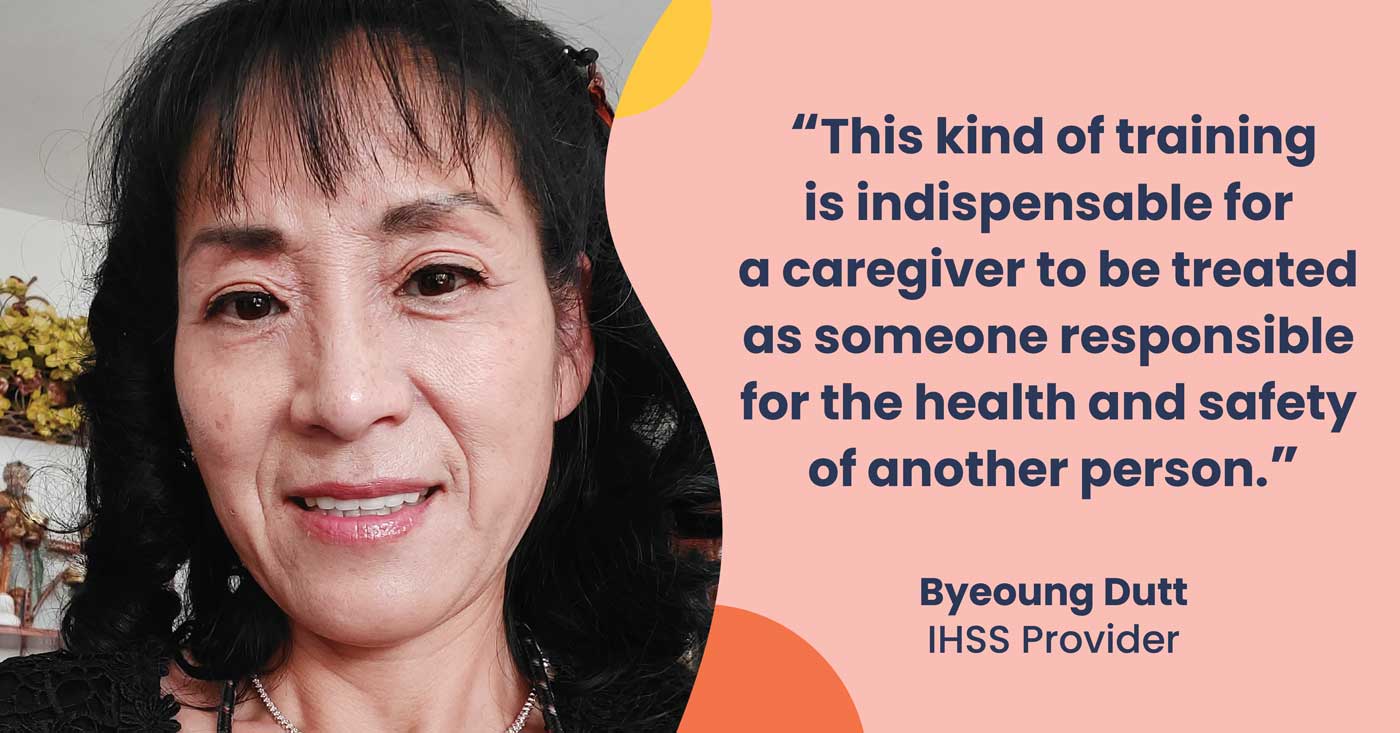
When caregiver Byeoung Dutt has questions for her care recipient’s doctor, she uses Google Translate to help her write down her thoughts in Korean, then English. She does this to overcome some common language barriers in caregiving.
“If there is an abnormality in his blood sugar, blood pressure, or overall health, I report his condition by emailing or calling his doctors and nurses,” says Dutt. If her report is too complicated or if her question involves more technical terms, she asks for an interpreter to help her translate the conversation. But there is a difference now in how she communicates with the care team. Thanks to CCA’s caregiver training offered in Korean, her native language, “I have gained confidence in my job.”

Overcoming Language Barriers in Caregiving
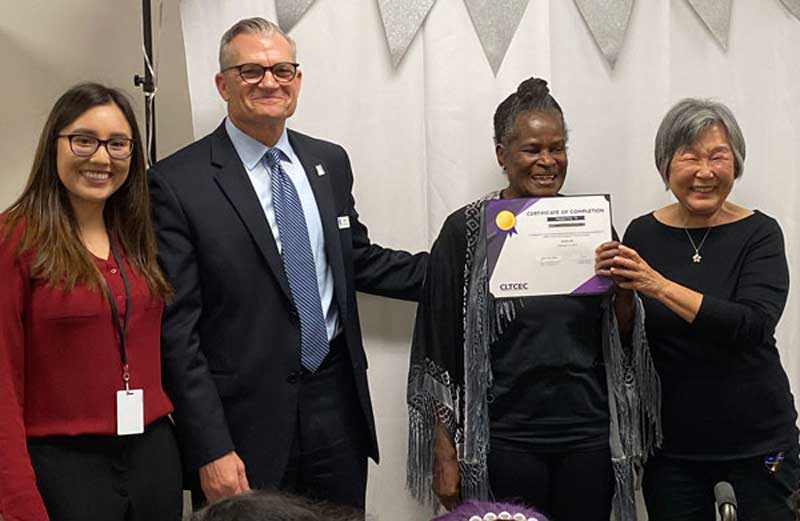
Dutt completed CCA’s 10-week caregiver training for In-Home Supportive Services (IHSS) providers in Los Angeles County. The course covers essential caregiving skills, including medication adherence, assisting with daily activities such as dressing and bathing, proper nutrition, and CPR.
To help overcome language barriers in caregiving, this course is taught in several languages: English, Spanish, Armenian, Cantonese, Mandarin, and Korean.
More than a million of direct care workers, roughly one in four, in the nation are immigrants. In California, almost a quarter of the home care workforce is Asian/Pacific Islander.
“Getting training in my native language allowed me to understand 100% of all this training, and to see the connection between what I learned last week and what I will learn this week,” Dutt says.
Improved Quality of Care Through Training
She cites the modules on safety and durable medical equipment (DME) as an example. She says that because the course was taught in Korean, “I understood that the medical equipment is necessary to prevent the consumer from falling. I made a connection to the learning before and after, so I understood more quickly and easily.”
Because of the caregiving skills she learned during her IHSS+ training, she now keeps a daily record of her care recipient’s vitals, medications, and general observations about his health and any unusual behaviors so she can communicate any changes and concerns with his care team.
Training Helped Her Earn the Respect of the Clinical Care Team
Caregiver skills training helps change the perception of caregivers. The doctors and nurses begin to see the home caregiver as an integral part of the care team. Training has given Dutt the chance to clarify what caregivers do, she says.
“This kind of training is indispensable for a caregiver. It helps them earn respect and be treated as someone responsible for the health and safety of another person. It helps me show that I am not just a housekeeper.”
Her diligence and professionalism have not gone unnoticed. The pharmacists, primary doctors, and medical staff she talks to have told her that the person she is caring for “is very lucky” to have such a skilled caregiver.
“Because I am taking care of him in a better way for his health and his quality of life, based on that training, I am filled with pride,” she says.
She is particularly appreciative that she was given the opportunity to receive training in her language to overcome language barriers in caregiving.
The Center for Caregiver Advancement’s IHSS+ Home Care Integration training program is offered in partnership with L.A. Care and SEIU Local 2015.